5 Days, 5 Ways to Style the GrandPro Rally—Working From Home Without Most of Your Clothes Edition
One hour. That’s all you need, really. One motherfudging hour to get your motherfudging work done. But the kids keep coming, don’t they? Every couple minutes or so, absentmindedly rubbing a stick of butter against the stairwell or dripping watercolor paint on the dog or screaming over a “broken” iPad that’s simply run out of battery power. Pint-sized Captain Americas, these lot—relentless, always wanting you to either feed, entertain or clean up for them.
So: how are you gonna get that time?
By donning that swimsuit you bought in Mexico, the one to replace the one your better half finally admitted was WAY too thread-bare for you to be exiting a pool in any more. You are gonna put on that flamingo swimsuit and you are going to tell your kids that if they’re nice and quiet and don’t interrupt Daddy until he gets his work done maybe we can all go to the pool and go swimming. Yes, the one with the slides and the tall diving board. And when they ask you if you’re serious you can say, “I’ve got my swim trunks on, don’t I? THAT’S pretty serious.”
“But it’s April, and aren’t all the pools closed anyway?” Hell yeah they are. But there’s no way these adorable little heathens AREN’T going to interrupt you, so you’re absolutely safe. No one’s going swimming. No one’s going anywhere. And maybe you’ll only get 45 minutes, tops. But it’s better than nothing.
Pairs well with a down coat because it’s still freaking freezing out here in the only quiet spot on the property, and a T-shirt that says “THIS IS SUPPOSED TO BE FUN,” because it is.
5 Days, 5 Ways to Style the GrandPro Rally: Working From Home Without Most of Your Clothes Edition
WEDNESDAY: You know what can bring a little bit of coziness to a cold, gray, unfeeling world? A flannel shirt. You know what today needs? Three flannel shirts. And it would’ve been five if the other two didn’t have macaroni and cheese spilled all over them. Screw it. Let’s dig through the laundry hamper, pull those bad boys out, scrape the stains away with the lid off a can of tuna and get cozy AF in here while we contemplate how the hell life brought us to this point, and whether we’ll ever get to go outside and lick random things like we used to.
Goes well with a hat from the college your son is now locked out of, the only pair of jeans currently in your possession that doesn’t have a rip in the butt, and a palpable sense that every time you walk outside you’re the only one taking this whole 10-feet-apart-please thing seriously.
NOT PICTURED: The homemade mask you fashioned out of a coffee filter, a unicorn T-shirt your daughter grew out of two years ago that you still have lying around in the back of her closet, and the rubber bands off of a wilted stalk of broccoli.
Q: What is that you’re wearing? Is that a Speedo and a cardigan?
A: Four weeks ago, I boarded a flight from New York to San Francisco for a two-day photo shoot with two laptops, a paperback copy of Harry Potter and the Order of the Phoenix, and any clothes that fit in the remaining space in my backpack. Of course, being thisclose to Portland from the Bay Area, I’d added a weekend stopover to my trip. And so, on Friday March the 13th, I left San Francisco for Portland for what I thought was going to be just a Saturday-Sunday joyride before catching the redeye to JFK Sunday night.
Obviously, we know how the rest of this plays out. I’ve not been back to New York since.
This is, of course, about as lucky as a guy could get in the face of a global pandemic. I found myself already in Portland, with my family, when the numbers really began to escalate. I did not have to fly back into the epicenter of the Coronavirus universe only to try to find my way out again. And I had everything on me in order to continue to work remotely.
Well, almost everything.
Four days of clothing. Given that’s all I thought I’d need, that’s about all I had in my bag. A few rolled-up pairs of underwear, some socks, a few T-shirts, a zip-up fleece and some running stuff. After all, sweaters are bulky and you can just keep wearing the same pair of jeans and no one will notice, right?
Only now, people notice. The few people who actually see me on a daily basis notice everything I’m wearing because I’m wearing it so damn often, and they’re seeing me even more than that. I had some clothes at home in Portland—but they’re mostly out-of-season things and old sweats that harken back to a time in my life when I dressed like I was a four-person tent.
So I’ve had to get creative. And because I’ve had to get creative, and because I like to make an ass out of myself and document it for others, I have taken my wardrobe, my current situation and a pair of shoes and created my own personal working-from-home style guide, complete with stories behind each “outfit.” It probably won’t spark any ideas for you. But that’s not really the point.
Because everything seems so difficult these days, I’m showing up late, with both Monday and Tuesday in hand. That’ll change as of Wednesday. Thanks for your patience. It shows you care! (Or that you don’t, so much, because this is really a pointless and ridiculously frivolous exercise!)
5 Days, 5 Ways to Style the GrandPro Rally: Working From Home Without Most of Your Clothes Edition:
MONDAY: The one remaining pair of clean socks goes perfectly with a sweatshirt you stole out of your son’s closet, and that pair of basketball shorts you painted the trim in.
TUESDAY: The last time you spent this much time indoors surrounded by your family? The holidays. Happier times. Okay, okay: less terrifying times. Why not try to bring back some of that magic, by dusting off those expensive novelty reindeer pajamas that the whole family wore for that one picture before shoving into the very back of their closet? Pair it with a white button-down and a wool crewneck—because you read in Refinery29 that getting dressed up would be a sure-fire way to keep you from feeling so f#cking sad about all of this.
I didn’t want either of them. So I wrote an acceptance speech for both of them.
Q: Why the sad face?
A: I’m an Elizabeth Warren stan. Which has made this week particularly hard—though frankly the last few were all pretty big stinkers. Having grown up in Cincinnati and attended to the University of Missouri, however, I’m pretty familiar with the concept of losing, and long ago developed several coping strategies for such events. The very best thing to do in these situations—when your horse is either out of the race or its rider has fallen off and been trampled to death—is to look to the front and talk yourself into one of those remaining hard-charging horses.
Now, it should be said: I’m going to vote enthusiastically for whoever winds up being the Democratic nominee. I’m not really a fan of dictatorships; particularly not ones both so willfully ignorant and profoundly dangerous. But I also recognize that I’m not everyone. And having just witnessed the person I felt most embodied the ideals of a president forced to bow out for reasons I cannot understand let alone stomach, I wanted to convince myself that either of the remaining distinguished gentlemen could be someone worth rallying behind. So I poked around on their websites—Joe, can you at least let me in the door before you start asking for money?—checked out their policies, and watched a couple of speeches. Then, I wrote a speech of my own, for each, for the end of the Democratic National Convention. A fruitless writing exercise of a heartbroken voter, trying to talk themselves into going to the prom with someone else. And while I won’t pretend the pain is gone, it did make me feel a little better.
Q: Is that them? They’re only a page apiece.
A: Yep. I tried to get them even shorter. Like, Gettysburg Address brief. You win, Mr. Lincoln. Lincoln was a man ahead of his time; he would’ve been a force on Twitter. ANYWAYS…yeah. My greatest hope is that, when the real one comes along, it blows mine out of the water. Time will tell…
Bernie Sanders:
My fellow Americans, this moment is for all of you. We are all one step closer to a return to democracy as it was intended. By the people, for the people. My job as your next president is to hand this country back over to the people of the United States.
Some have branded me a socialist. They say it like it’s a bad word. But what I really am is a relentless optimist. I believe in you. And I believe that we can do better. And by “we” I don’t mean the people of this great nation. You’re already doing enough. You’re working longer hours than you ever have, for comparably lower wages, and paying more in health care than you ever have, and paying more for education than you ever have. You, friends, can take a load off.
No: I mean your elected officials who comprise your government. We have been chosen, by you, to represent you. We have been empowered, BY YOU, to look after you and your best interests. And it’s about time we did that. For ALL Americans.
Everyone living in this country deserves the right to dream. I’m talking basic dreams, for all people. A dream of feeling safe in your communities. A dream of financial security, of quality education and job training, of affordable health care. A dream of a healthy environment in which to live, for generations to come. You’re not asking for much. Just not to have the deck stacked against you making something of yourself. America has long been known as the land of opportunity. For a while now, only the privileged few could honestly say that was the case for them. Tonight marks a turning point toward making it true for all Americans. To give everyone a foundation to build a better life for themselves, and the power to make their own way in this world. STARTING with those who face the most risk, the greatest disadvantages and the worst discrimination. “With liberty and justice for all” only works if we truly mean all.
So I’m an optimist. But I am also a realist. I know that initiatives such as these are not possible without the buy-in of my coworkers in Congress. I certainly should know; I’ve been there long enough. So let me assure you that as president I will be working every day and with all of your representatives to turn this talk about reform into pragmatic action and lasting change.
But what I will not do—and what we cannot do—is defer the dreams of all Americans while we wait for politics to catch up. Democracy has always led you to believe that your vote mattered. But that is only the case if those you’re voting for act in your best interests. That is what I will be doing from Day One. Giving each and every American a vote that matters, then rewarding you for making that vote.
Thank you, and good night.
Joe Biden:
My fellow Americans, it brings me great honor to stand on this stage tonight as your nominee for the next President of these United States of America. Your faith in me is something I will never take for granted. It’s been a hard-fought road to this point, and a necessary one. I stand here knowing more about the hopes, the dreams and the resiliency of the American people than I ever have.
I want to thank my fellow candidates for the spirited discourse along the way. Their passion, their experience, their grit, and their know-how has pushed me to become a better person and a stronger nominee. I will take the lessons I’ve learned forward into the next fight, that most crucial fight. And many of the ideas you brought to the table will light that way forward, for all of us.
Officially, we are the United States of America, but for the past few years it certainly hasn’t felt united. The current administration has taken great pleasure in dividing us. They want to split us up into wealthy and poor, urban and rural, and along racial and ideological lines. They want to sow doubt and mistrust among us, so they can strip this nation of its values, its resources, and—with them—its hope. They would like nothing more than to stir fear among each and every one of you, so that they can take advantage of all of you.
That, I’m sure, is not the vision any of us have for America. It certainly isn’t mine.
This goes beyond uniting us under a common set of ideals, however. Our prosperity as a nation is dependent upon the health and well-being of its citizens. All of you out there contribute to the fabric of our society. You make it a richer and deeper and more diverse and wondrous place when you are able to engage and contribute. But the divide between the haves and have-nots threatens not just the concept of American democracy but the very real day-to-day lives of its people. I have heard of your struggles. You are all constantly forced to make the hard decisions, the deep sacrifices, to put yourselves and your futures at risk just to make it from one day to the next. This is not the America you were born into. It is not the America you signed up for. If you’re struggling just to survive, where is your opportunity, in this famous Land of Opportunity?
Right now, it’s in your power as a voter. You can choose fear, you can choose apathy, or you can choose a future. You can go to the polls, or the mailbox, and pick the side of unity, and humanity, and basic human rights. You can raise the floor—for yourself, for your children, for each other. Affordable health care. Quality education. A clean environment. Only one option of the three offers these to you. But when you vote for your future, those basic rights are yours to keep. Your American dream will be a few steps closer.
If New York wants to seriously call itself the best city in the world, it needs to fix the washing machine.
This machine swallows quarters.
Q: Where are you going with all that stuff? Are you moving out?
A: Hah! I wish! This is seven weeks’ worth of dirty clothes, towels and sheets, tied up in two precariously thin garbage bags and teetering down the sidewalk on a child’s skateboard I salvaged off a particularly possessive alley opossum.
Q: And what’s that rattling sound I hear?
A: Why, that’s the $20 in quarters tucked inside the back pocket of my jeans! Don’t worry: in a couple of hours, the rattle will have completely disappeared.
The fact that I have to pay for the luxury of doing my own laundry feels like the biggest step backward I’ve ever taken in terms of personal development. The fact that I have to do it with actual currency, in the form of quarters, is downright travesty.
I don’t know if you’ve tried to find a quarter when you need one these days—chances are you haven’t, because who needs quarters anymore?—but it’s essentially impossible. Thanks to credit cards, Apple Pay and Venmo, the very idea of hard currency is disappearing. As are the change jar, the swear jar, the cookie jar, the piggy bank, and any other easily breakable vessel I might hammer in order to scrounge up enough money to provide me with clean T-shirts for the week. These days, if we had a couch, digging through the cushions might yield a lot of things—but a quarter would not be one of them.
And it certainly wouldn’t cough up the 15 required to do a single load. Quarters have now become more precious to me than—well, let me give you an example:
I came home this past weekend, and though I only brought a backpack I stuffed it so full with dirty clothes that the zipper made that low, gargling sound when I went to close it. First thing I did on Friday morning, even before putting on water for coffee, was split the clothes in two piles and start a load of darks.
On the other end of the weekend, on Sunday, at a pizza place that has a number of coin-operated ‘80s-era video games, I gave my 7-and-½-year-old daughter a $5 bill to make change so she could play Miss Pacman. When she returned with the quarters I handed her only 4 back.
“Why are you keeping the rest?” she asked.
“Because I have laundry to do,” was my answer.
This is what I mean by valuable: I’ll deny my daughter the joys of my own childhood in order to make sure I have plenty of coins come laundry day. And why? Because a place that considers itself America’s greatest city and the fashion capital of the New World has YET to bring its laundry situation out of the dark ages.
The closest washers and dryers to me lie six floors directly below our apartment, in our building’s laundry dungeon. The elevator ride down—it feels like you’re trapped inside the world’s first commercial microwave oven—deposits you in the basement, directly opposite the trash room for the entire 66 units in the building. You then walk right, past the trash chute, before hanging a left through a doorway into a sloppily painted brick cellar with a red clay tile floor whose drain in the middle is clotted with lint and dog hair and random clotted-blood bandages. The door to the outside is perpetually open, meaning that not only is the laundry dungeon cold enough to store dairy products but smells at all times of dog shit and cigarettes as you pull your clothes out of the washers or dryers.
Speaking of washers, our building’s 5-dozen-plus units are served by a total of three washers and four dryers. One of those washers is a front-loading unit that, though at least 20 years younger than the rest of its kin, is always unplugged, always out of order, and always resting in a puddle of its own making, like it’s pissed itself from the stress. That leaves two top-load washers for well over a hundred people. And though those washers do indeed turn on, add water, and shake one’s clothes back and forth a bit, I do not know if I would call what they’re doing technically washing. Agitating feels more like it. Often I pull my white load out and am convinced that they’ve become dirtier by virtue of having run through these two machines.
As I might have alluded to earlier, the washers and dryers in the building only take quarters, via the old stand-on-end, punch-and-retract coin boxes we’ve seen in movies from the ¾-mark of the 20th century. Only we’re shin-deep in the 21st century now, nearly 50 years past that point. I can buy $400 in groceries instantly using a scan of my face by my phone—the same phone I used just minutes before to search, book and pay for a plane ticket home. But I have to lug around seven quarters for each and every load of laundry I want to wash, and another eight per if I want the luxury of having those clothes dried—via, I might add, a dryer that smells of sun-cooked squirrel. The world has converted to digital currency, but if I want to get the coffee stain off my jeans I have to take two giant leaps back in time and wrangle up a shitload of change like I’m the tax collector in some Bible story.
No doubt you’ll have assumed by now that even this has become a difficult task. The only people dealing in quarters anymore are the laundromats, only they don’t want you using their change machine if you’re not going to plug that change directly back into their services—which on the whole are 150-200% more expensive than my building. Of course my building doesn’t have a change machine—that would be too easy—so I have to resort to sketchy methods in order to feed my habit of wearing clean-ish clothes.
First I have to procure a bill of rather significant denomination.
Then I need to find a place that has change.
Then I have to trick them into giving me the change.
Sometimes I can cause a distraction by casually mentioning that the Knicks just scored, and slip a crisp Abe Lincoln into the auto-dispenser before the Adam-Sandler-in-Uncut-Gems lookalike guarding the change machine looks back from the tiny TV, disappointed, and catches on. I can’t risk the time it takes to make $10 or $20 in change—no Knick scoring streak is going to go on that long—so I always end up on the shy side, quarter-wise. My next scheme was to fake interest in opening a bank account at the local credit unions, just so they’ll take an Andrew Jackson and turn it into 80 metallic George Washingtons. By the end they always have figured me out, and that’s how I became persona non grata in every back within walking distance of the apartment.
So now I seek out my actual bank, a bank that has things like brass door handles and clean windows and warm cookies and a dress code and actual standards of conduct, and ask them if I can take $40 out of my checking account and ohbythewaycanIpleasegettheentireproceedsinquarters. The man smiles, straightens the knot of his tie, and nods, and always asks,“Laundry, right?” And I can’t think of anything else to say than, “Yep,” because not even the smartass in me is capable of coming up with a sarcastic or absurd response that warrants why I’d be carrying around enough quarters to turn a knee sock into a deadly weapon.
There’s got to be a better way.
And before anyone says, “There is: just send your laundry out to be cleaned,” let’s remember that I am horribly cheap and incredibly picky when it comes to who touches my stuff. Besides, this has officially become a crusade of sorts for me.
In tiny, patchouli-oiled, fashion-is-a-social-construct Portland, we’ve had to use a laundromat three times while we waited for our washing machine to get repaired. We used a credit card to pay for the washers and dryers, and sat in the in-laundromat cafe and had two glasses of cabernet under the glowing halo of free high-speed wi-fi while our clothes got sparkly-clean.
New York, you are a shining cosmopolitan titan of progress and industry. You consider yourself top of the heap when it comes to just about everything—from bagels to rock ‘n’ roll. Your residents’ favorite saying is, “The thing I like about New York is you can get whatever you want, whenever you want it. It’s so convenient.”
Well, New York: I want my clothes to be cleaned. Actually cleaned. At a normal hour of the day. In a fairly comfortable, wine-optional setting. Without having to rob a toll booth in order to make it happen.
You claim you’re the greatest city in the world. Here’s a great chance to prove it.
Like what you’re reading here? Don’t forget to actually “like” it. Something about an algorithm—I don’t know, we’re figuring this stuff out as we go along. There’s a button here somewhere… Anywhoo, thanks for reading!
Q: What’s the hardest part about living in NYC so far?
A: Well, before today I would’ve said it was laundry. And we’ll get to that some other time. But as of this morning, it’s paying my Con Ed Electric bill.
Q: How on earth is the hardest thing about living in America’s biggest city the simple act of paying your Con Ed Electric bill?
A: Because they simply charged me $4,261.94 this month. And they managed to get away with withdrawing it from my checking account, too.
Q: $4,261.94??? THAT’S IMPOSSIBLE!
A: THAT’S WHAT I SAID! And when they said, “Well, we installed new meters somewhere, and did some math, and—abracadabra—this was the number we came up with. This is how much you owe us. MWAHAHAHAHA.” I said, “STILL IMPOSSIBLE. I’ve lived there four months! That’s more than $1,000 a month! $34.37 worth of electricity a day! For a 650-square-foot-apartment with no air conditioning, one television, and five total lights. You’re insane! You must fix this, immediately!”
Con Ed apparently didn’t see it that way. The fact that—thanks to automatic billing—they had removed two mortgage payments from my checking account in a single swipe didn’t really seem to bother them all that much. Nor had it, for a while. The extremely unhelpful young woman on the phone admitted that my account had been flagged since December 10. And that accounting had been studying this sudden jump since January 8, but apparently had decided it wasn’t worth worrying about and sent out—and collected—the bill anyway.
We’re set up for automatic payments, because I’m the type of idiot who easily loses track of days themselves, let alone their significance within bill-paying cycles. For three bills that had meant fairly agreeable little withdrawals from our checking—especially in October, when the heat finally abated and I could pull the AC unit out of the window. But apparently that sudden dip was what got ConEd suspicious, so they came over, read some meter—hell, it could’ve been the odometer on their Econoline van for all I know—then decided that Bradley and I were charging a fleet of Teslas out our fifth-story window. ConEd’s bean counters rolled up their sleeves, licked their pale, thin, chapped lips, and happily plucked the cost of a 2008 Honda Fit out of our account.
I wonder why, when organizations are particularly thick-headed, it’s never in your favor. The ConEd guy always accidentally reads the meter for the whole 66-unit building and assigns it to your account, instead of getting the decimal in the wrong place and only charging you $9.17 for the month. The waiter always double-charges you for the expensive bottle of wine, instead of accidentally bringing free dessert to the table. The world feels like such a cruel and unforgiving place sometimes; it’d be great if fortune occasionally tipped the other way. After all; it’s not like ConEd’s gonna have creditors coming after it if IT’s short $4,261.94 for the month. (Unless, well, is THAT what this is, ConEd? Did you put too much on the Nets to win it all this year?) It’d be great if the little guy caught a break every now and again.
Particularly if that little guy looked a lot like me.
The good news is, I have an amazing bank, who stopped to question whether it seemed in-character for me to open up a five-story tanning salon inside our apartment. They stepped in and stopped the payment and prevented us from going broke as a result of my clearly insatiable thirst for power. (I kid, ConEd. Still using just one lightbulb and one phone charger a day. Also: Go fuck yourself, you miserable utility. You disgrace the very concept of “utility.”) Anyway, as I was saying, First Republic intervened and helped where ConEd wouldn’t, staving off a potentially disastrous situation. I’ll have to deal with whatever ConEd’s diabolical future plans for us are in the next week or two. But at least I’ve been able to breathe again for the last couple of hours.
And, tentatively, laundry has gone right back to the top of the heap.
Me, at 44, and finally beginning to look like what would happen if Wolverine applied to be Associate Branch Manager of the Moline Bank of America.
When the calendar turned over to my birthday I found myself wide awake, in full-on process mode, like that period of time between when you push “Print” on a document and when the printer finally begins spitting the page out. I’m not normally a person who suffers from insomnia—I’m more like one of those dolls who, when you put them horizontal, their eyes immediately close—but apparently, lying in a still admittedly strange place by myself as the odometer rolls over on another number to the sound of a toilet flushing overhead will make a person stay up and think about the choices they’ve made to this point.
I will confess to being one of those terrible people who believe that birthdays are arbitrary calendar smudges not worth the cost or fuss of the gift bag, while secretly hoping that someone will show up at my place of business with a giant cookie positively afire with the exact number of lit candles melting a hard wax surface across the top of the cookie. And in this fantasy I tell them that they shouldn’t have and I will mean it, but I will also close my eyes with the utmost earnestness and make a heartfelt wish and blow every single one of those candles out, only to have them relight of their own volition. And we will laugh and laugh and laugh because wasn’t that a funny joke to play on an old man.
This one—my 44th—feels even more like some kind of tightrope walk between dread and excitement. Because it’s looking ever more through the rear-view mirror that at 43 I very likely had my own special version of a mid-life crisis, one that I’m clearly not out of. That raises a shitload of questions. Questions like:
Q: Is this really just the middle?
A: 44 years sure seems like a long time, you know? But people are living longer and longer these days, and Heidi has the goal of reaching 106, so I guess this might not even be middle-life. Still: I’m not sure these shoulders are designed to dead-lift all this stress for another 62 years, if I’m being honest. So 88 seems like a very good, very round number. Totally doable. Only: gosh, the first 44 seemed to take an eternity to get here. The thought of doing it all over again, only to feel worse in the mornings than I do now and to watch the hairs sprout like dandelions from my ear canal and to get up and worry whether that mole on my chest was there the day before and could this be the one that turns out malignant, the one who turns all the others and my own skin against me; well, let’s say I’m having a hard time getting excited about my future prospects. I should probably say I actually feel very lucky to be in the shape I’m in, physically and mentally. I know things could be a lot worse. But I also happen to know that they’re heading that way; that biology is no longer on my side. There’s a lot of middle ground to cover still, hopefully. But I need to get my act together if I don’t want the back half to be one long trip to the doctor’s office.
Q: Is this really all we have to show for the first half?
A: Not really a fair question. After all, I have a LOT to show for Years 0-43. Not the least of which is my family. But I did think I’d be far further along in something of a career I was proud of. Instead, that part feels like I’ve barely started. Better late than never, but even knowing that retirement is likely another two decades(!) away, it doesn’t feel like I’ll get where I want to be in time to really enjoy so much as a slice of ripened fruit from all my labor.
George Orwell had a quote: “At 50, everyone has the face (he) deserves.” Six years is not a long time to lift this face into something I want to spend time with every day. Makes me wonder exactly what I’ve been doing so far. Speaking of which:
Q: What’s next?
A: The hardest, and therefore best, question. And I’d certainly hoped that after five months of subjecting myself to this grand mid-life experiment we’d have more of an answer. But honestly it feels like the more this goes on, the farther away we are from figuring things out. We—Heidi and I—seem to be making decisions that contradict the ones we made only minutes earlier. After all, if you want to move to New York, the one thing you DON’T do is buy a labrador puppy. But then again, if you AREN’T moving to New York, why are you talking to real estate agents and bank people about moving there? It makes no sense; we make no sense, except to each other. That’s enough for now, but it won’t be come Spring. And though it should be of some comfort that all the options feel viable and potentially positive, that only serves to make it worse. After all, there’s a reason romantic comedies always have one knight in shining armor and one soulless louse; two shiny knights would just blind our leading lady with indecision. Who wants to make a judgment call that’s not freaking obvious? Not me, clearly. Though 44 looks like the year I might just have to.
The solace I take? If it’s the wrong one, at least I’ve got about another 43 years or so to make up for it.
I’ve been writing a Christmas letter for some version of my family since 1992, when I was 16. The first few were mean-spirited and absurd, a response to another family friend’s detailed list of annual overachievements. The worst happened to be 2008, the year I got divorced. The addition of four people into my life in 2011 meant an entirely new and robust cast of characters to write about. That’s when we started with the double-sided version. One side: a big update of everyone. The other side: seasonal meanderings.
I’ll spare you the details of who got their wisdom teeth out. Happy Holidays, everyone!
Honestly? Sometimes I’ll just forget, though it’s never for long. I’ll be working on some fun project at work, or a day at the office will be going really well. (The new job—the one in NYC that I took while the rest of the family stayed in PDX—goes really well a lot of the time. I have never felt so empowered, fulfilled or excited to get to work. It is the saving grace of this venture.) But as soon as the day’s over and I step out of the office, the gulf between me and many of my favorite people lengthens to an intimidating scale, and my brain wracks itself as to what I’ve done and whether it’s possible to keep doing it.
Heidi and I try as best as we can, and modern technology makes this more possible than ever. But you can’t lifehack a three-hour time difference. Which is why, this October, I became the human version of Home Depot. I so desperately yearned for the Christmas season to begin (along with my accompanying 12-day homestay) that I tried to find ways to will it into an early existence.
Okay: one way. Short on time, living space, and funds, I made myself a Christmas playlist. One that hit all the sappy notes without making me burst into tears between the Chambers and Canal Street stops. One that had enough upbeat Santa-based songs to override the desire to rent a car and buy a box of adult diapers and hit I-80W after Judy Garland sings, Until then we’ll have to muddle through somehow. It’s five hours long, 97 songs in total. But the highlights are below. Consider it my “gift” to you:
“All I Want for Christmas Is You,”Mariah Carey. Enough has been written this year about this song and its gradual ascent into the Christmas canon. Personally speaking: The fact that I can bop along to the 50s-era beat while the lyrics make my heart pine to be with my baby is why it kicks off this playlist.
“Linus and Lucy,”Vince Guaraldi Trio. Playing the entire “Charlie Brown Christmas” album on repeat makes this city feel more playful and warm-hearted, even as I’m dodging angry pedestrians wielding their Bed Bath & Beyond bags at me like they’re medieval weaponry and I’m Cersei Lannister.
“Let it Snow! Let it Snow! Let it Snow!”Frank Sinatra. I loved this song, right up until Frank’s reference to frightful weather made me imagine being stuck in LaGuardia in a blizzard for Christmas. I suppose I’ll be able to enjoy it more as soon as we’re wheels-down in PDX. Then it can snow all it wants.
“Have Yourself a Merry Little Christmas,” Next year all our troubles will be miles away. Oh Judy. I hope you’re right.
“Please, Daddy, Don’t Get Drunk This Christmas,”John Denver. Just a gentle reminder to myself after the Fall I’ve had.
“Santa Claus is Comin’ To Town,”Bruce Springsteen. The quintessential New York-sounding Christmas song, half-sung and half-yelled into a megaphone. I have a newfound appreciation for it this year. It’s the only song that can drown out a subway entering a station.
“Run Rudolph Run,”Chuck Berry, for much the same reason. So many of the other songs wound up being downers that I needed the Chucks and the Bruces of the world to pull me out of my tailspin.
“Christmastime is Here,”Vince Guaraldi Trio, again. Because it sounds like snow falling on an empty street. And the sound of kids singing gets me every time.
“The Man With the Bag,” Kay Starr. A big blast of horns and we’re off. I like to think that when Kay sings Everybody’s waitin’ for the man with the bag, she’s talking about me, showing up at the house with two duffels full of dirty laundry and a backpack that contains not one single Christmas gift.
“The Man in the Santa Suit,” Neil Halstead. Funny. Sad. Pretty much sums it (and me) up.
“Christmas (Baby Please Come Home),” Darlene Love. I hope whoever Darlene was singing this to was listening. I hear it, and immediately start looking for one-way flights to Portland.
“Please Come Home for Christmas,”Charles Brown. I avoid the Eagles’ version at all costs. Besides: this version actually sounds like he’s talking about a person, instead of a pile of cash.
“I’ll Be Home for Christmas,”Bing Crosby. By this point I always try to be back in the apartment, before the facade cracks. If only in my dreams. Sing it, Bing. I’ll be over here in the corner with my Eggnog White Russian, wiping the dust from my eyes, and thankful I’m home again at last.
A: You should know this by now. We’re pretending this is an advice column. Please phrase whatever you’re trying to say in the form of a question.
Q: You look…terrible?
A: Thanks. I feel terrible.
Q: What happened? Stay up all night drinking?
A: Replace “drinking” with “thinking” and you’re getting warmer.
Let’s rewind a bit:
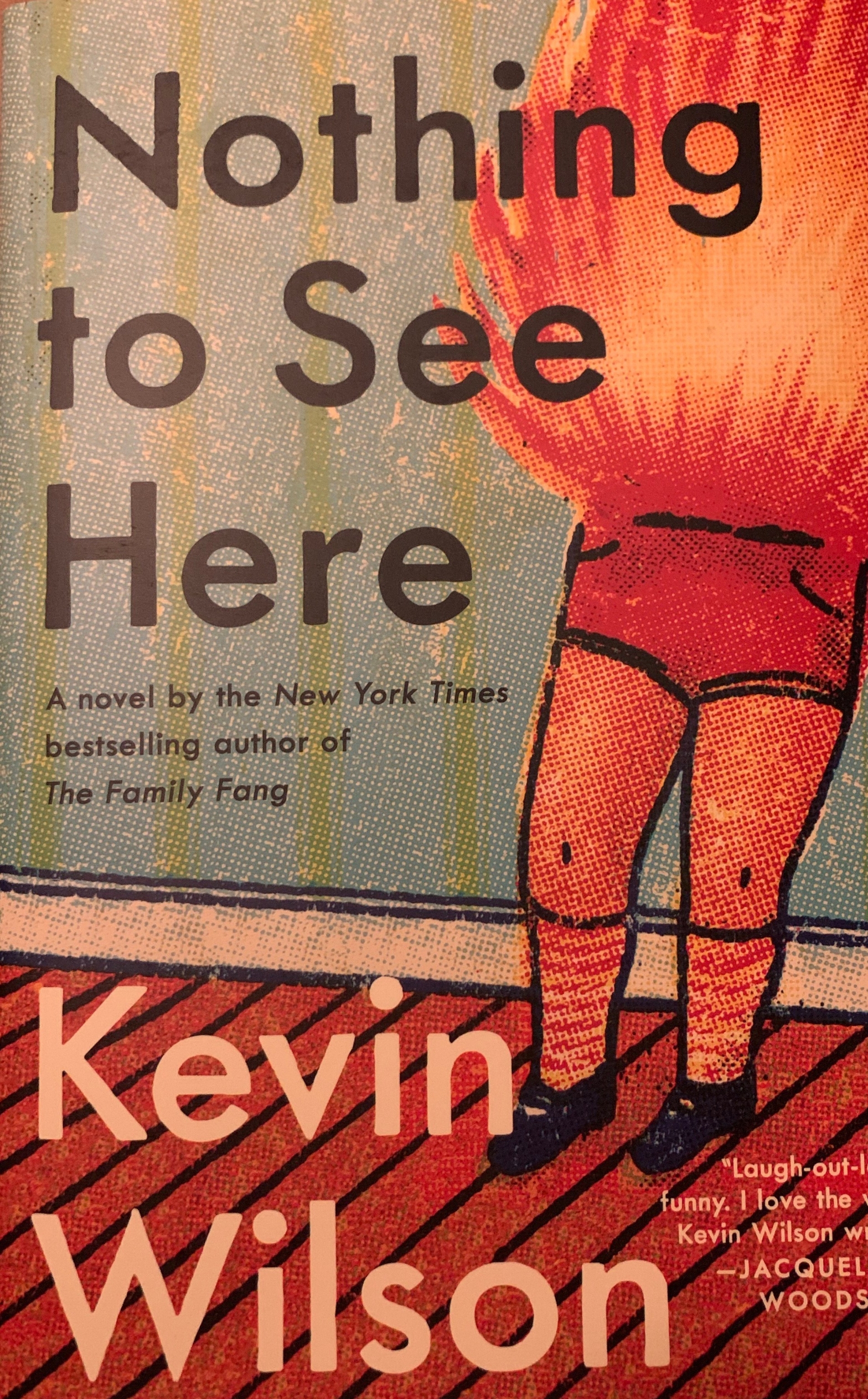
One of my favorite evenings in New York so far was a mid-October Wednesday spent at Books Are Magic listening to author Kevin Wilson speak. Wilson wrote The Family Fang, one of the funniest books I’ve ever read. His latest, Nothing to See Here, has gotten rave reviews. Wilson writes the types of stories I can only dream of writing—funny and unafraid, empathetic and yet ruthless with their characters. In person, he was funny and engaging and warm and thoughtful and as kind as could be. Which made the fact that he wrote the entire first draft of Nothing to See Here IN A MERE 10 DAYS feel, frankly, like a bit much. I mean: if you’re going to be talented AND prolific, can’t you be just a little bit of an asshole about things, Kevin?
Wilson’s pace seems to lie somewhere between maniacal and miraculous. But walking out of the reading, signed copy of the book in hand, I’d decided two things:
I was going to write to thank him, and
I was going to get over my damn fussiness and speed the hell up.
Most of the stories you hear about novelists are of the long-suffering type. That a single book took a decade to write, or that only by squirreling themselves away in a cabin three hours’ hike north of Reykjavik for an entire winter were they able to even figure out what their character’s first name was meant to be. Those stories have always given me great comfort; because ever since I’d started trying to write longer-form books I’d equated the process to trying to carve the Venus de Milo with a feather. My brain enjoys the puzzle of finding the precise word, simile, turn of phrase, etc.—to the point that it will not move on until it’s out-clevered itself. That may be fine, in bursts. But when you have to do it 5,000 times over the course of a book, it’s more than merely wearying to write, but to read. And besides—it takes up the luxurious type of time I’ve never had. Writing a memoir took nearly four years; the manuscript sits, mostly unread, on my computer. Writing a novel based on that memoir took another two and a half years; five whole people have read it.
The math is humbling: My ratio of hours of work to audience size is embarrassingly high. I don’t expect many more people to come along clamoring to get their hands on my writing. But hearing Wilson speak was a blast of cold water to the face: Could I not at least write faster?
Fortunately I had the perfect project upon which to push TURBO. My youngest, P, and I have been lobbing fragments of a story back and forth at each other from the time she was in kindergarten; one about a girl who is kidnapped and taken to space, with the burden of saving the Multiverse thrust upon her. We’d just never gotten very far with it. Upon moving to New York I picked at it whenever I felt homesick, or whenever she asked about it. It was coming along at the sort of pace my writing typically did. Which meant by the time I got it to a point where I would be happy with it as a work of fiction, she’d be too old to want anything to do with it.
I came home and put Nothing to See Here on my desk by the lamp as a reminder of my newfound and outlandish intent: finish OUR story in time to have a book, printed and under the tree for her, by this Christmas.
Q: And I’m guessing, by the bags under your eyes and the way your mouth’s just kinda hanging open, that you managed to achieve that goal?
A: All 55,000 words of it. The printing company sent out a note letting me know that five hardcover copies shipped Dec. 21, via express mail. It’s in Indianapolis, on its way to Portland, as I type this.
And let me just say: five copies may be all wrapped up, metaphorically and literally speaking, but I know what I’ve written is by no means perfect. I’ve already thought of about nine pretty significant aspects I would like to add or change, on top of whatever thoughts P has. But having made it all the way to the end of a book in such short order, “significant” no longer bears such an uncanny resemblance to “insurmountable.” Finishing took me about 40 days, which looks sluggish next to Wilson’s—but compared to my past attempts, that feels like a World Record. Meanwhile, I’ve learned there’s a time and a place for all of my compulsive rewriting, and that’s once the damn story’s actually been written. When you can see the whole animal, it’s easier to decide what’s a major organ and what’s simply fluff that you’re free to spend a couple seconds on then ignore. Seems logical. I consider myself a fairly logical person. Not sure why figuring out this point took me about 30 years.
I’m so grateful to Kevin Wilson for the not-all-that-inadvertent effect he’s had on my work from here going forward. Mostly I’m just grateful to him because now my little girl—who’s gone so much time this fall without having her dad around, and has been so patient and understanding and more concerned about me than she has herself—will get to open a present on Christmas day that is special to her. A 250-page apology note that tells her just how much I miss her every single day. And a unique and wholehearted expression of all of my love and appreciation.
Relatively accurate approximation of what it feels like to run in Prospect Park on any given day of the week.
Q: Why are you wearing that ridiculous outfit? You look like a tube of lipstick wearing a knit cap.
A: Because I made a bargain that if my friends and family raised over $180 for P’s Run for the Arts fundraiser, I’d run 20 miles—80 laps of a standard track. Only I’ve been putting it off, and now I really need to get out there and do it, but it’s snowing outside. There are three layers under here.
Q: But you WERE a marathoner, weren’t you? And you still run, right? This should be no problem for you.
A: Sure, at one point I did run a marathon or two (or 14). But I would no longer consider myself a marathoner, or really much of a runner. That version of myself peeled off its nipple guards years ago. The last time I ran 20 miles was also the last time I ran a marathon, and that was all the way back in 2011. Coincidentally enough, it was New York, and I kind of did it on a whim.
Q: People shouldn’t run marathons on whims.
A: True. In fairness to me, I’d had about 20 years’ worth of base training built up to that point, and took the actual race far more sensibly, pace-wise, than most of my previous attempts.
Q: So how’s training been going for this fool’s errand you gave yourself?
A: You heard me say it was snowing, right?
Q: Fair enough. But tell me: What’s it like, running in the big city?
A: Well, the good news is that the mechanics are the same. Right-left, right-left until you get tired: then turn around and run back. The logistics are quite another, and you need to head out the door with a different mindset if you want to make it back to that very same door in one relatively well-put-together piece. Having run in Chicago for four years right out of college, my lizard brain knew all of these things already. But I’d been spoiled for years, working for a company that didn’t have just one fitness center but three, featured a full 400-meter track on site, and had miles of running trails right across the street. This is before we even get to Portland’s vast trail system and uber-welcoming running community. My first week of running in Brooklyn, I was lucky to not get busted for indecent exposure, hit by a passing ambulance, and/or wind up floating in the Hudson.
I was totally unprepared, is what I’m saying. But you can do better than me. Here are a few suggestions as to how:
Remember your keys. My locks at home are keypad entry. My locks at the apartment are numerous and as old as Buckingham Palace. The keys look like the keys cartoonists draw when they need a pirate to open a chest he’s excavated. And if I forget them, I’m locked out on the street until B comes home at 11:45 at night, because there is NO WAY I’m striking up conversation with my neighbors. They’re unwieldy (the keys, not the neighbors). They often determine which shorts I’m going to wear, or force me to put on a jacket even when it’s 70 degrees out, just to have a decent pocket. The only good news is they pull double-duty by jangling so much that I don’t need to warn people of my quickly approaching presence from behind.
Bring along plenty of toilet paper. You’ll need it to line the seat AND wipe your seat AND get in and out of the port-a-potty. My first run in Brooklyn I had completely forgotten this aspect of running in a city; I’d been spoiled by always being within a half-mile of a clean, flushing toilet at all times. My colon, a mere 10 hours removed from a cross-country plane ride and the accompanying airport cheeseburger, decided three miles from home that he was done with his job for the day and it was time to bail. Immediately. I checked 11 bathrooms, found only one I would even consider stepping inside, and only then discovered that someone had taken every last square of TP. I clenched and crab-walked it home, vowing to never again leave the Place without half a roll of two-ply stuffed in my shorts.
Memorize your route. I don’t run with a phone. Nor should you—it’s an HOUR. DETACH ALREADY. But unless you’re a Coho salmon, ditching the phone means losing your most common way of determining how to get anywhere. So do definitely figure out beforehand exactly where you’re going, and find some landmarks to help calibrate your bearings. Personally, I would’ve thought it was easy. Run south until you hit the park, do a loop, run home. But there’s a large traffic circle right off the park, and I went one exit too early on the return trip. All the streets looked the same, there’s a grocery store on each of them around the same spot, so next thing I know I’m totally turned around. I head right, thinking it’s taking me North; it’s actually sending me due East. I was aiming for Fort Greene; I wound up at a Baptist church in Stuyvesant Heights, where a very nice couple of old people who’d lived there their entire lives disputed over where Fort Greene was and which way to send me. Eventually they had me head all the way back to the park, before turning back for home. Five miles had become 8. Now I do the same run every day. It’s boring as hell, but hey: At least I’m not trying to walk home from LaGuardia while my keys cut away at my appendectomy scar and my colon threatens to give out!
Look both ways. About a dozen times. Wherever you live right now, know that the people around you respect the concept of traffic signals to a far greater degree than New Yorkers do. I’ve been nearly run over by everything from school buses to little old ladies with shopping carts, all of them crossing intersections against the light. Even I run the reds now. But I always quadruple-check that no one’s coming before I set a foot off the sidewalk. I don’t want to be the live-action version of a Wile E. Coyote skit.
Don’t get caught up in the fact that it feels like a race. A step inside the 3.3-mile loop at Prospect Park feels like entering the Thunderdome. There are about a thousand people running there at any given time of the day. And if it’s a weekend? Triple that number. Bikes are zooming past you on your right, so close their aggression feels intentional. People and their dogs are shuffling across the street at varying speeds, though never one fast enough to get out of the way. It is a moving bar fight, and a lot of it is all headed either at you or in the same direction you are. When you’re used to tranquil runs in the woods with a few friends, when that is the state of running that you’ve grown not just familiar with but reliant upon, all these people and all this action can start to create an anxiety that feels very similar to race day. Don’t fall prey to that. Take a deep breath. Remind yourself that nobody’s handing out medals at the end of the loop. Not even if you blow by that colossal turd of a human being who seems to be accidentally-on-purpose legit SPITTING at people on his way past them. Not even after that. Even if they should.
Give people as much room as you can. But know they likely won’t do the same. It’s called exhibiting common courtesy. It’s also called looking up ahead of you. Rare is the runner who possesses the ability to do both at the same time. And finally…
If you don’t go looking for dead bodies, you won’t find any dead bodies. No side trails. No scenic jaunts to the old abandoned sinkhole. And no opening port-a-potties unless it absolutely will not wait. Stick to the trail, hurdle anything that’s just hanging out on the ground, and keep your head up. You do all that, and everything’s going to be just fine.



 Ask a Stray Dad